
Project Update
OSCE brings climate-security perspectives and regional experience to discussions on National Parks in the Anthropocene
- Issued on:
- Issued by:
- Office of the Co-ordinator of OSCE Economic and Environmental Activities
From 11 to 13 June 2026, representatives of protected area management authorities from South-Eastern Europe and Central Asia participated in the 2026 Forum Anthropocene in Heiligenblut, Austria.
The annual international interdisciplinary event brought together representatives from national parks, academia, policymakers, local authorities, civil society and the private sector. The Forum provided a platform for dialogue and knowledge exchange on the interconnected challenges of climate change, biodiversity loss, urban planning, regional development, public health and the contribution of protected areas to strengthening resilience and security. Further, it served to connect protected area practitioners across regions, strengthen partnerships and promote dialogue.
“Our experience has shown that transboundary and neighbouring national parks can serve as powerful platforms for dialogue, confidence-building, and practical co-operation. From South-Eastern Europe to the South Caucasus and Central Asia, examples show how collaboration around shared environmental assets can transform common challenges into opportunities for stability, trust, and peace,” said Sylvie Goyet, Deputy Co-ordinator of OSCE Economic and Environmental Activities.
The OCEEA, in collaboration with the OSCE Project Office in Dushanbe, OSCE Presence in Albania, the OSCE Mission to Kosovo and the OSCE Mission to Skopje, supported the participation of protected area representatives from South-Eastern Europe and Central Asia, including partners from the shared protected areas of the Shar/Šara Mountains and Korab Massif. Their participation further enriched the discussions by bringing practical perspectives from protected areas facing climate and environmental challenges. These partners are engaged in ongoing OSCE initiatives to address climate-related security risks, including wildfire risk reduction and the prevention of illegal logging, aiming to strengthen the capacity of local and regional stakeholders to respond to environmental challenges.
Resulting from these efforts, and on the occasion of the Forum, the OCEEA published the policy brief Addressing Illegal Logging and Climate-related Security Risks in the Shar/Šara Mountains and Korab Massif Area. It outlines key drivers and impacts, presents options to strengthen co-operation and reduce risks, and aims to close knowledge gaps, raise awareness, and foster regional dialogue.
“To hear and learn from experiences from other parks has been inspiring and will continue to shape my work in the years ahead. Albania’s protected areas are vital assets, but we face challenges related to development pressures, enforcement of legislation, including increasing occurrence of wild fires. Exchanges like this help us identify shared solutions and strengthen the way we manage and protect our natural areas in the face of emerging challenges,” said Klodjan Sula, Director, Regional Directorate of Protected Areas, Diber.
“Participating in the Anthropocene 2026 International Forum in Austria was an excellent opportunity for me to learn and exchange experience, because it is through sharing knowledge and experience that we can strengthen the management of protected areas and implement best practices,” said Firdavs Khudoyorovich Khudoyorov, Head of Department, State Institution “Specially Protected Natural Areas”, Committee for Environmental Protection, Tajikistan.
This activity was supported through the OSCE extrabudgetary project, “Strengthening Responses to Security Risks from Climate Change in South-Eastern Europe, Eastern Europe, the South Caucasus, and Central Asia,” which is implemented in partnership with adelphi and funded by Andorra, Austria, Czech Republic, Finland, France, Germany, Italy, Ireland, Japan, Liechtenstein, Luxembourg, Norway, Poland, Slovenia, Sweden, Switzerland, United Kingdom, and the United States.
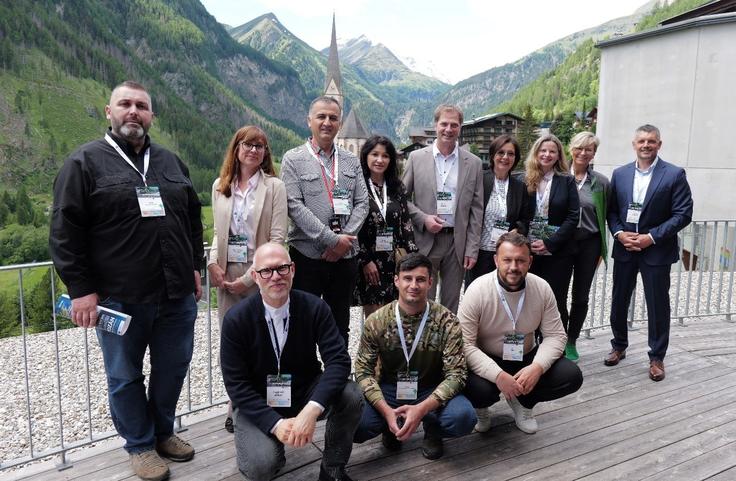
representatives of protected area management authorities from South-Eastern Europe and Central Asia